
Tom Lake
by Ann Patchett

Lara and her husband Joe are running the family orchard in northern Michigan when the pandemic begins in 2020, and their three adult daughters, Emily, Maisie, and Nell, come home for the duration. In the framing narrative, the family lives out their beautiful life on their beautiful farm, loving each other and entertaining each other as best they can. While the three young women mourn what they’ve been missing since the world shut down, they ask their mother to tell them the story of her own youth. Specifically, they want to hear the story of her long-ago love affair with an actor, Peter Duke, who has since become very famous. Lara and “Duke” meet at a summer stock theater company called Tom Lake, also in northern Michigan, where they are both in a production of Our Town.
The three daughters and their questions give us a lovely entry point into Lara’s story, as they know only the barest outline of their mother’s brief career as an actress. Each character is fully developed, and it’s easy to imagine their lives outside the confines of the novel. The narrative weaves in and out perfectly between Lara’s daily life and the story she tells her daughters. We also get the thoughts that remain after she has told that day’s piece and has time to herself to remember what she will never say out loud.
Authenticity is a huge theme in the novel, as the big question keeps coming up—if you’re dealing with actors, does anyone know when they’re acting and when they’re being authentic? Do they themselves know? At what point do you lose that sense of who you truly are? Lara hangs on to her true self, but there’s ambiguity surrounding Duke for the entire novel. It’s unclear how much he’s already embodying the role of Actor, even during the early days. We already know that Duke and Lara don’t end up together, so we’re primed for a crash. But Patchett writes the scene where they meet expertly. We all fall for Duke immediately, even knowing that there’s no way he’s being entirely genuine. Lara explains why they immediately begin their romance by referring to summer stock time, when the days are numbered and every minute has to count. It’s a lovely parallel to time in the novel itself, which takes place over the course of a summer that only temporarily brings the family back together. If she doesn’t jump in feet first at Tom Lake, she might miss finding out about this beautiful man. If she doesn’t tell her daughters this story now, they might never have another chance to hear it in its entirety.
Patchett uses the incredible natural beauty of the setting in two ways: on the orchard, Lara has traded the ephemeral for the perpetually gorgeous, while at Tom Lake, the beauty can last only for a season. Then, we know, the characters will go their separate ways. It’s in the name—summer stock. Like a riveting play or a film, that summer cannot last, so the actors snatch at every opportunity to surround themselves with the beautiful scenery. Since then, Lara has built a life that includes that world, forgoing the seasonal excitement of the next acting project. As these two worlds collide, we contrast and compare the same setting at different points in time. At one point, Lara wonders how to get out of the past. Her husband jokes that the only way out of the past is through. Patchett takes us on a lovely stroll through the past, up to the present, using the beauty of nature to reflect the different seasons of Lara’s life.
Our Town and the part of Emily run through our protagonist’s brief acting career and, while I’m sure there are deeper references here, it’s not necessary to know the play well to understand why Patchett chooses this play and this part. (I don’t know the play.) What we learn from the novel is that Emily’s journey from innocence to death mirrors the birth and death of Lara’s career. Her first part in any play is that of Emily, she is “discovered” as Emily, and she plays Emily again at Tom Lake, her last performance. That last show marks the end of her own innocence. Unlike Emily, who dies too young to appreciate all she has in life, the Lara we meet on the farm savors every moment of her own.
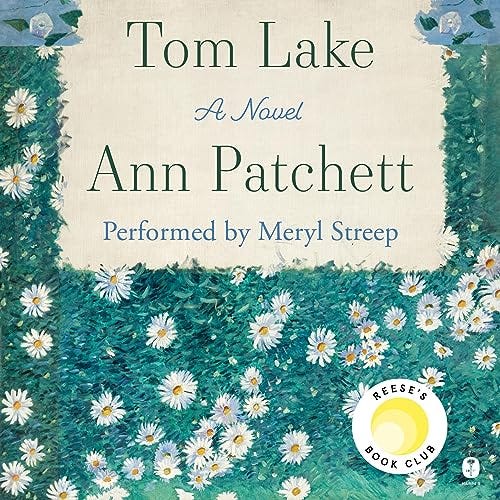
“Lovely” is a word I have wanted to use again and again, writing this. The audiobook, read by Meryl Streep, is so lovely that I often did nothing but lay down and listen; it’s rare for me to listen without doing something with my hands. I could hear the rattle of plates as the dinner table was tidied up and taste the cherries they picked. Ann Patchett has a knack for writing beautiful things, but Tom Lake is exceptionally gorgeous, made all the more so for its infuriating or tragic moments. It does return to the uncertainty of 2020, but this is balanced by the reassurance of a functional and loving family living quietly beautiful lives.
Ann Patchett is one of my favorite authors and I can’t wait to read this. This is such a LOVELY review!
Can’t wait to read it