
This Other Eden
by Paul Harding

This Other Eden is heartbreaking and gorgeous. I can easily see why this was short-listed for the Booker Prize. It’s based on the tragic true story of Maine’s Malaga Island. Apple Island, like Malaga Island, is a racially-integrated community off the coast of Maine founded in 1792 by a mixed-race family, the formerly enslaved Benjamin Honey and his Irish wife, Patience. Their descendants and others who would face prejudice and hatred on the mainland, including adopted Penobscot siblings, join together to live peacefully, bothering no one. In 1912, however, a well-meaning but racist teacher and missionary becomes determined to educate the island’s children. Because of the attention he brings to the island, eugenicists take it upon themselves to remove its residents, send them to institutions, and create a vacation destination. We find out about the beginning and the end of this community right away, and the novel is an exploration of what it means to find and lose family and home. It moves gracefully back and forth in time and points of view.
Of course, in a novel about an island, water is bound to be significant. The ocean sometimes protects by keeping the world away, sometimes provides in abundant fishing, and sometimes tries to kill everyone in storms and floods. A story about the island’s first family is a clear reference to Noah’s Ark, with everyone clinging to the tallest tree to stay above a raging sea. They are submerged but do not drown. It’s a baptism that washes away any connection to the outside world.
The Biblical references continue with the apple trees for which the island will be named. Benjamin Honey has collected seeds from all over the world, but without the knowledge of how to nurture the plants, he loses most of his trees. The flood destroys the rest. While he does replant, this time with more knowledge of how to nurture the trees, they quickly disappear from the story and the island. This little bit of knowledge of the outside world mirrors the little bits and pieces used by the island’s inhabitants throughout their history. They go to the mainland (literally, Maine land) for supplies and then use them until they absolutely cannot be used any longer. In part, they simply lack the funds to purchase new clothes, among other things. But they also instinctively know that too much contact with the outside world is dangerous. They preserve their Eden by embracing their isolation. Poverty, even of knowledge, does not phase them
.
As in the Bible, trouble begins with new knowledge—the arrival of Matthew Diamond, the missionary and schoolteacher is immediately disruptive. The adults remain skeptical of Diamond, even as several of the children excell at art, reading, and math, respectively. Indeed, while Diamond admires and may even love some of these children, he is ashamed to find himself “disgusted” by the Black and indigenous adults. Their lack of shame about their mixed-race heritage parallels the lack of shame in Eden around nakedness. This literal shamelessness flies in the face of the established social order on the mainland.
The most worldly character is Zachary Hand to God Proverbs, a Civil War veteran who lives in a hollow tree and carves elaborate Biblical scenes into the “walls” of his home. These interior carvings contrast sharply with the outside world’s insistence on religious conformity. Zachary maintains a deeply personal connection to God and the Bible. The islanders respect his knowledge and devotion, and he does not expect them to adopt his brand of religion. He completely baffles the mainlanders.
Zachary is also the most vocal opponent to letting anyone observe the Apple Island way of life, and this is clearly tied to his experience in the Civil War. Unlike the more sheltered community members, he has seen violence on a mass scale. He has also seen citizens of the same country turn on each other, dehumanize and other the opposing side. This is what he fears and expects, prophetically so.
The tragedy of the novel is that the very innocence that “this other Eden” has protected gets ripped away by the outsiders who impose hierarchy. The residents of Apple Island lose home and family to a world that cannot understand and outright refuses to examine the value of that experience and community.
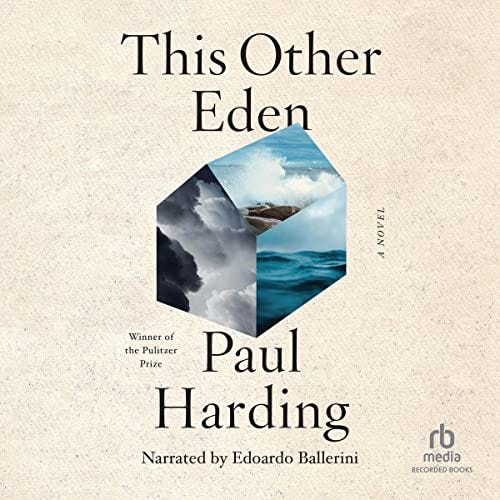
I highly recommend the audiobook of This Other Eden—Edoardo Ballerini is always an excellent narrator. He’s one of the narrators in Trust, which I absolutely adored, and also narrates the Silo Saga, by Hugh Howey, which I also recommend.