
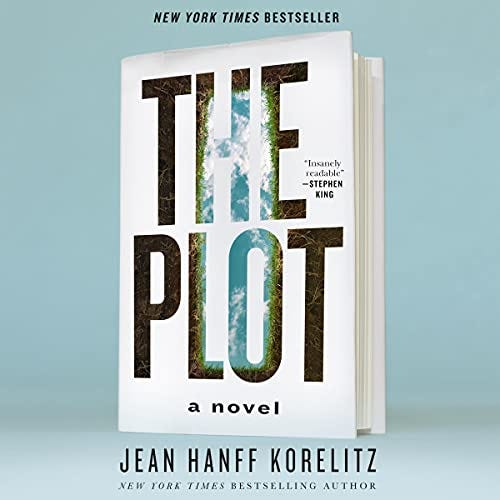
The Plot
by Jean Hanff Korelitz

The Plot follows Jacob Finch Bonner, a once-celebrated author who is finding it difficult to replicate his success—or write anything at all. When we meet him, he’s teaching at a mediocre low-residency MFA program reciting platitudes he doesn’t believe to students he doesn’t respect. He’s not a particularly likable character, but he’s not supposed to be. He’s more concerned with whether or not his students have heard of him than he is with their progress. A particularly obnoxious student declares that not only is it generally “impossible to teach writing,” but also that he in particular needs no help because he has a plot that cannot fail. He’s reluctant to reveal the plot, but one night in Jacob’s office, he tells all. As the title suggests, Jacob gets a chance to steal that plot following the death of his former student, Evan Parker. For a few reasons, this seems risk-free, and he grabs the opportunity. This novel was recommended to me because I enjoyed Yellowface, which follows a similar story (see review here). In both books, mysterious antagonists begin threatening to expose the authors as frauds. Who is behind the threats? Who could possibly know about the stolen plot? What will they do if Jacob doesn’t give in?
All of this does sound familiar, but comparisons with Yellowface don’t go very far. This one is in third person, so we’re not following an unreliable narrator. The tone is very different, as The Plot follows a more straight-forward, traditional mystery/thriller path, while Yellowface centers around the mixed-up mind of its protagonist. The questions in The Plot are about who gets to tell this particular story, rather than the larger cultural questions in Yellowface surrounding which kind of author is allowed to tell which kinds of stories. Although each protagonist longs for fame and accolades, Jacob has had a taste of this early in his career, and his torture is that he is being pushed to the margins, with fewer people recognizing his name. The Plot has us wondering less about what’s going on in Jacob’s head and more about the kind of danger he’s in from the outside.
The novel uses the thriller structure to raise the stakes of its questions surrounding authorship. Jacob chases down every lead, traveling far from home as his obsession with finding his accuser grows. At the same time, the threats become literally closer to home. This mirrored behavior ratchets up the tension and gets us to stick with Jacob. As he seems more like a victim, we have more sympathy for him. As he begins to unravel the mystery, we become more invested in its outcome.
Another theme is the question of where a good story comes from, and Korelitz explores this by shrouding the stolen plot in mystery from beginning to end. Does it follow a straight line from student to teacher, or does it have murkier origins? Jacob rationalizes what he’s done by claiming that a good story deserves to be told, must be told, and this one has clearly been abandoned. He tries to give the story itself agency. At one point, a lawyer informs him that it isn’t possible to copyright a story, but while his actions may not have been illegal, this is hardly an adaptation of an existing tale. Jacob fears exposure so much because he didn’t change anything—he didn’t just base his novel on someone else’s idea, he copied that idea’s every twist and turn. It gets more interesting when he goes looking for the history of the story itself. Did Evan Parker share its details with anyone who might be behind the threats? Are there manuscript pages lying around, and if so, how closely do they resemble Jacob’s work? It occurs to Jacob far too late to wonder where Evan got the idea in the first place.
The one objection I have to the novel is that characters keep claiming that the twist in Jacob’s work is impossible to guess. Well, the book includes excerpts of Jacob’s novel, called, ironically enough, Crib, and it’s not that hard to guess where it’s going. Korelitz is careful not to let Jacob’s explorations get ahead of those excerpts, but I figured it out nonetheless. I also guessed the major twist of The Plot before it was revealed. Where the book succeeds is that even when I guessed what was about to happen, I still wanted to read more. I wanted to know exactly how it would all play out.
If you’re looking for a good thriller, definitely read The Plot!