
The Bee Sting
by Paul Murray

I read The Bee Sting because it was short-listed for the Booker Prize, and I try to read as many of those books as possible. The list is very reliable. In this case, the novel is, in fact, very well-written. Its characters are real and spring off the page. It’s just not my cup of tea. Fair warning: this review contains minor spoilers, because I can’t figure out how to talk about it without exposing little things.
The book examines what happens when deep dysfunction goes untreated, so to speak. It infects the community on every level, from the family to the town, in the past and the present. For example, the novel takes place just after Ireland’s 2008 market crash, but the Barnes family pretends that nothing is wrong, that their car dealerships will start earning as much as ever very soon. In town, a building that used to be home to a Magdalene laundry represents a dark past residents ignore as much as possible. Wherever we look, someone is in denial about something vital.
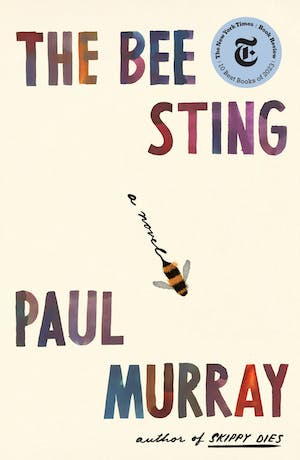
The Bee Sting has four narrators, and each switch allows us to see a bit about how the other three are in denial. They are the four members of the Barnes family—PJ, twelve, Cass, his teenage sister, and their parents, Dickie and Imelda. PJ and Cass are both in denial about their best friends, leading to dangerous situations. Cass spends time binge drinking rather than studying, then panics about her end-of-school exams. These are forgivable sins. They are children, after all. But Dickie and Imelda argue, loudly, about cutbacks in their household budget, while simultaneously refusing to talk about how their money woes are impacting their children. Imelda simply starts selling her jewelry and other things around the house, leaving the kids to notice that things like matching furniture sets have gone missing. Dickie first goes into work every day as though the economy has not crashed, then stops going into work to build a bunker in the woods behind the house. PJ pretends that his father’s new obsession is a normal building project. It would take me pages to list all the problems these characters pretend do not exist.
Revelations about these characters did keep me reading, as the many flashbacks relate the stories of the family’s origins. The characters are almost always more sympathetic during these flashbacks. Perhaps I’m just willing to forgive youthful transgressions more than parental neglect and bad adult decisions. The title comes from an incident relayed early on about Dickie and Imedla’s wedding day. When Cass asks her father why there are no pictures in the house of the wedding, she learns that a bee became entangled in her mother’s veil on the drive to the church and stung her in the eye. This, she is told, caused her beautiful and rather vain mother to keep her veil over her face for the entire day, even during the reception. Everyone wonders about this, of course, but no one pushes Imelda to enjoy her own day. They pretend as if the veil isn’t there. There’s a great deal more to this story, but we don’t learn that until close to the end of the book. The titular bee sting and the veil are a metaphor for the secrets and lies told in order to keep the surface smooth. This didn’t quite save the novel for me, but I absolutely love what Murray did with the wedding day plot line. It’s beautiful, elegant, and powerful.
While the beginning of the novel examines day-to-day life, letting us get to know the characters, the latter half is driven by escalating events. Cass goes off to university, PJ grapples with being left behind in an impossible situation, Dickie stops going to work, Imelda contemplates an affair. What I can’t forgive is that it all comes to a head at the end… and the book just stops. I watched the seconds tick down on the audiobook and thought “But there isn’t time for the ending!” I understand that the final moments are a metaphor for what Dickie and Imelda have wrought, but I wanted to see the consequences, even if just for a moment.
One final thing that bothered me, and this isn’t the book’s fault—the only place to get the audiobook is from Audible. I used a free trial period to get it, because I have a hard time reading accents I can’t sound out in my head. Overall, I clearly don’t recommend this one. But that’s not really its fault, either. As I said, it’s well-done but not my thing.