
North Woods
by Daniel Mason

Set in the woods of Western Massachusetts, this novel begins with the breathless flight of a young couple from their colonial Puritan community. Mason proceeds not with their story alone, but with the stories of characters who live on the land throughout the centuries. At first, they live in a rustic cabin, but this is followed by a yellow house that lasts—it becomes the primary setting, alongside the sweeping, beautiful countryside. While the setting of the novel remains stationary, time marches on, through twelve chapers roughly corresponding to twelve months. I am reluctant to tell the stories of any of Mason’s characters, because knowing nothing about this book going in made each revelation a delight.
The novel might have been a series of short stories, if not for the way each layer builds on what came before. Indeed, Mason has an incredible talent for making us feel deeply about the characters and the land in a very small amount of space. Were these stories told in reverse, we would be excavating the property, uncovering layers of sediment that reveal clues about the lives of previous generations and changes to the setting itself. But because they unfold from past to present, the work makes a statement about the ephemeral nature of time and the way it removes so many of our footprints. Fortunes rise and fall. Families pass down the property, or they don’t. As in nature, everything changes.
One character finds clues as to the whereabouts of a historically significant site on the property, but the land itself prevents him from uncovering the secrets we know. There is a push-pull here that defines much of the novel. Even though we know where the evidence is, and part of us wants one generation to uncover the stories of the past, we also end up longing to protect earlier characters’ privacy. We feel a sense of loss as we accept the probability that all evidence of past will crumble into dust. We also feel a sense of relief that no one will ever know the private joys and sorrows witnessed by the land. Even the yellow house that stands for such a long time seems to protect previous inhabitants.
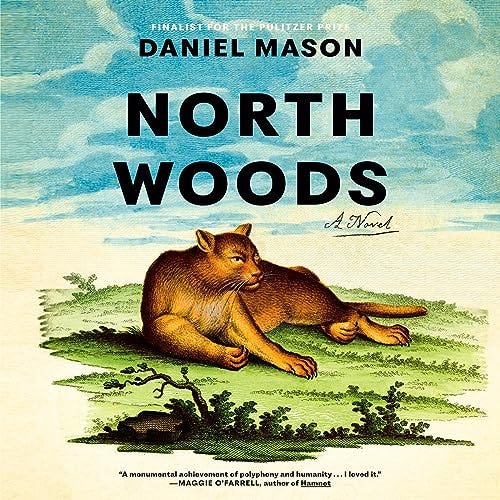
Some of my favorite passages in North Woods follow nature itself, particularly creatures such as a “catamount” (mountain lion) who stalks the land or a beetle who carries a blight to a beloved forest. Each has an important part to play in the developing history of the woods. We grieve over the loss of trees, like the American Chestnuts and the elm trees that die from disease. Because our characters love the land so deeply, we fall in love with it as well, remembering each spot for the way it connects to each story.
This novel is stunning, just absolutely beautiful. It seems that everything has a personality, from wild woods to an apple orchard to the homes that occupy the property. Even the road that leads to it becomes a sort of character. I cannot emphasize enough how masterfully and quickly Mason makes us fall in love with this piece of land, and how efficiently he sketches each character. Treat yourself to this wonderful book.