
A Restless Truth
By Freya Marske

In this sequel to the romance novel A Marvelous Light, we follow Maud Blyth, the stubborn and fearless sister of book one’s Robin Blyth. In the previous book, Robin and his true love Edwin set off in Edwardian England to unravel a magical conspiracy that could change everything for magicians and non-magicians across the country, perhaps even the world. In A Restless Truth, Maud is entrusted with the second piece of the puzzle. Or rather, she attempts to escort the elderly woman who knows about that puzzle from New York back to England. The problem is that a murderer strikes almost immediately. They steal whatever they think might hold this great power everyone is after. In a twist on a classic murder mystery, Maud is trapped on an ocean liner with a killer and only five days to solve the murder and recover the precious magical object. She immediately makes friends, falls in love with a woman named Violet, and faces down every danger in her path.
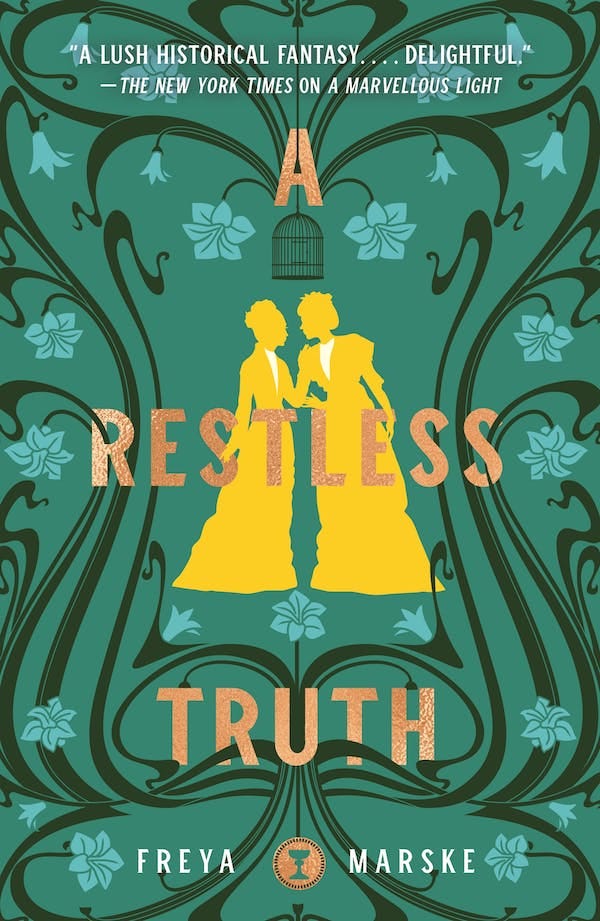
Given the cover of this one, it was obvious that it would involve a lesbian or bisexual romance. When I learned that the main protagonist was Robin’s sister, I wondered how Marske was going to pull off two queer siblings in one family. It just seemed so unlikely that both of them, given the repressed early twentieth century setting, would acknowledge such taboo feelings. But Maud’s sexual enlightenment on board the ocean liner has more to do with her insatiable curiosity than repressed longings. We already know that Maud wants to go to Cambridge, and that she has suffragette leanings. She wants to know everything, and that soon includes sex.
Secrets play an interesting role in these novels. Given the short time she has on board the ship, Maud must decide immediately who she can trust, although she has some magical help in narrowing down her potential targets (friends and enemies). Magic is an enormous secret, and we learn a great deal about a character based on how they react to the revelation of that secret, or when and to whom they decide to reveal it. Much like magic, love between women can be kept secret in plain sight. Passionate female friendships are commonplace, so no one thinks anything of Maud and Violet sharing a suite. A magical secret and the threat of its betrayal remain at the heart of this series. While she sometimes lets the line blur a bit, Marske separates the good from the bad largely by how they keep their secrets and why. The good protect, while the bad exploit. Of course, characters from either side occasionally step across that line, and that’s always interesting.
A Restless Truth explores more of the harsh realities of the status quo than its predecessor; everyone must stay in their place and social mobility is almost impossible. The only thing that makes it possible for a working man to join the original group of (wealthy) protagonists is that they can pay him to work on their mystery. The hypocrisy involved in “Society” is a related theme, as an inheritance restores Violet to some semblance of respectability after a few scandalizing years as an actress in a disreputable New York theater. But this is a kind of tolerance that seems to extend only to the sea voyage. The first class passengers who pride themselves on “good breeding” and social standing decide to overlook her outrageous behavior in the name of keeping the peace. They overlook the faux pas of the nouveau riche who are on their way to Britain looking for impoverished but titled husbands. It’s fun, at times, when the protagonists use these constraints to protect themselves or learn more, but for the most part, they have to work around social mores.
The more explicit scenes in this romance novel contrast inexperience with experience in a way that’s far more interesting than I first expected. Maud’s breathless excitement at the possibility to learn more about her body and sex in general leads to some funny moments, as well as tender ones. As with most novels in this genre, the text moves back and forth between the two women’s points of view. Seeing their sexual interactions through each character’s eyes makes them much more interesting and entertaining. There’s also a fascinating commentary on consent that’s unusual. It’s not a “consent romance” in the sense of asking permission before each touch, but the narrative highlights all the ways in which these women who do not know each other can accidentally thrill or cause harm. It’s hard to balance the care it takes to get to know someone with a whirlwind romance. I particularly love Maud’s journey along these lines.
Needless to say, I highly recommend these books. I can’t wait for the third one to come out in November!